
Symptoms
When you try to access a Web site that requires Silverlight to display the content, you receive an error message that states that you have to install Silverlight.
Check if the Silverlight Plugin is enabled. From your Safari menu bar click Safari Preferences then select the Security tab. Now click Website Settings to the right of: Internet plug-ins; Select Silverlight on the left then select Allow or Ask from the: When visitng other websites pop up menu on the right.
Cause
This behavior can occur for several reasons:
Your system has an earlier version of the plug-in and does not meet the requirements for the plug-in that the site is using.
You do not have the plug-in installed.
The browser is set to 'Run using Rosetta,' which will cause the computer to be identified incorrectly as a PowerPC-based Mac.
I downloaded onto my mac. I tried to open silverlight plug-in but then it says choose an application and won't let me choose safari nor firefox. Safari continues to support Java, Silverlight, Unity, and other NPAPI-based plugins. In fact, it’s the last modern browser to continue supporting these plugins. Even if you normally use Chrome or Firefox on your Mac, you’ll need to use Safari when you want to access a web page that requires a plugin.
How To Enable Silverlight Plugin
Resolution
Before you determine how to address the issue, you should assess the current environment in which the software is running. To do this, follow these steps:
On the Apple menu, select About this Mac.
Note the processor type, speed, RAM, and operating system information, as some Web sites have specific requirements to view their content.
Close the window.
Close all open browser windows.
Double-click the hard drive icon on the desktop.
Double-click the Library folder.
Open the Internet Plug-ins folder.
Is there a file that is named Silverlight.plugin? If this file exists, the plug-in is installed. To determine the version, click to select the file. Then, select Get Info on the File menu. Note the version number that is displayed.
If the version number that is displayed is 1.0.xxx and your processor type is a PowerPC, you have the correct version of the plug-in installed.
If you have an Intel Processor, all versions of Silverlight are supported. But we recommended that you run the latest version so that you can access Web sites that use the newest features and take advantage of the most recent product improvements.
Now we can address the individual causes and resolutions.
Your system has an earlier version of the plug-in and does not meet the Web site's requirements
The most common cause of this issue is that the Web site is using Silverlight 3 for its content. If a site requires version 3, it recognizes whether your system meets the requirement. If the system does not, you are prompted to upgrade. You are directed to the Silverlight site. If you are using a PowerPC, the site recognizes this and that only version 1 can be installed. (This situation would have to be addressed by the Web site's support team, as the decision on what version of Silverlight to use is made by the Web site designers.)

You do not have the plug-in installed
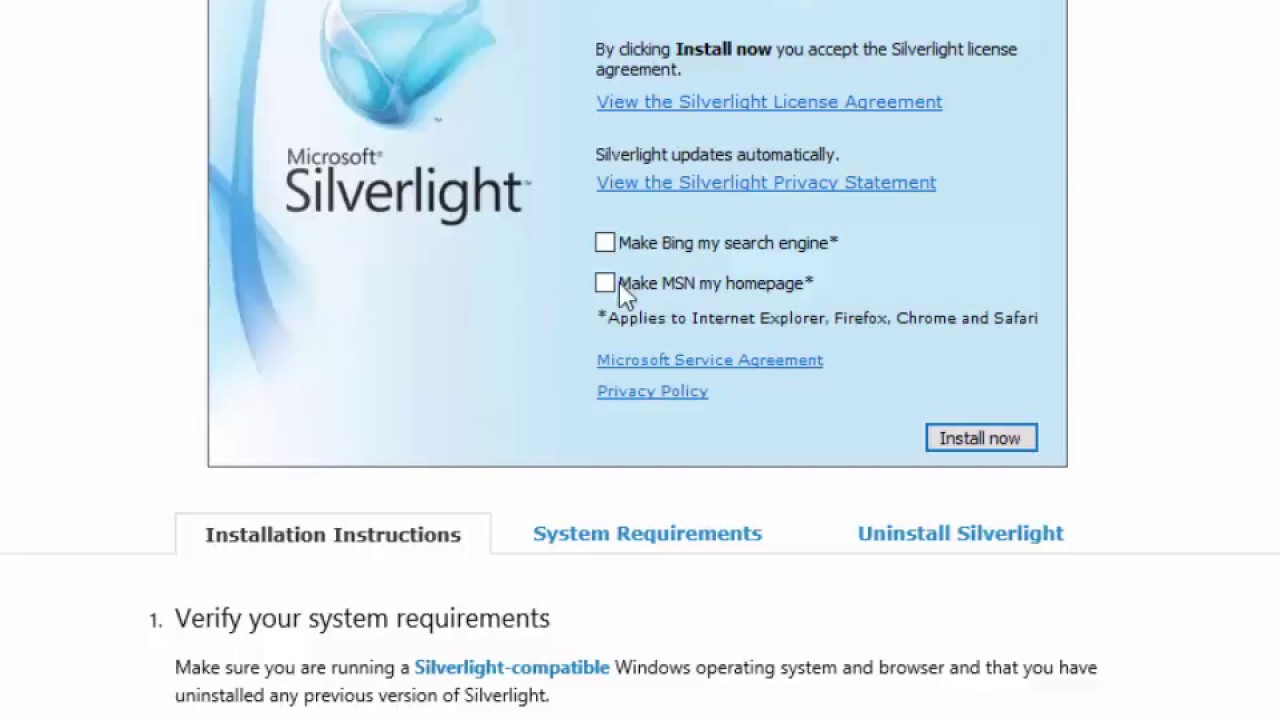
If Silverlight has not yet been installed, follow these steps to install the plug-in:
Start a Web browser, and then visit the following Web site:
Locate the 'Install Silverlight' area in the lower-right part of the window.
If you are running an Intel processor, click Mac Runtime next to 'Silverlight 3.'
Otherwise, click Runtime for Mac PowerPC next to 'Silverlight 1.0.'
After the download is completed, installation should start automatically. Follow the steps in the installation wizard.
After the installation is complete, you should be prompted to exit your browser. Close any browser windows, and then restart the browser. The browser should recognize the new plug-in.
Note If you have any problems with the installation, see the following Microsoft Knowledge Base article for information about how to manually install the plug-in:
970064 How to remove and manually reinstall Silverlight 2 for Mac

The browser is set to 'Run using Rosetta,' which will cause the computer to be identified incorrectly as a PowerPC-based Mac
If the browser is set to run in the Rosetta engine, it will incorrectly identify the computer as a PowerPC-based Mac, or the Web site will not recognize that the appropriate plug-in is installed.
If the appropriate plug-in is installed as described in the previous section, follow these steps:
Double-click the hard drive icon on the desktop.
Choose the Applications folder.
Find the icon for the browser that you are using. Hold down the CONTROL key while you click this icon.
Select Get Info.
Locate the Run using Rosetta option and make sure that this check box is not selected. If it is selected, click to clear the check box. Close the window.
On the Apple menu, click Restart.
After the computer restarts, again try to access the Web site that generated the error message.
Note If the appropriate version of the plug-in is not installed, make sure that the Run using Rosetta check box is not selected, and then follow the steps in the previous section to install the plug-in.
Safari extensions add functionality to Safari, so you can explore the web the way you want. Extensions can show helpful information about a webpage, display news headlines, help you use your favorite services, change the appearance of webpages, and much more. Extensions are a great way to personalize your browsing experience.
Use the App Store to conveniently download and install Safari extensions. All extensions in the App Store are reviewed, signed, and hosted by Apple for your security.
Silverlight Plugin For Safari

How to install extensions
Silverlight Plugin Safari 13
Start by installing the latest macOS updates to make sure that Safari is up to date. You need Safari 12 or later to get Safari extensions from the App Store.
Find and install an extension:
- Open Safari and choose Safari > Safari Extensions from the menu bar.
- The App Store opens to the Safari Extensions page, as pictured above. To download and install an extension, click Get or click the price. You might be asked to sign in with your Apple ID.
- Click Install.
- After the extension is installed, click Open and follow the onscreen instructions provided by the extension.
Then return to Safari to turn on the extension you installed:
- Choose Safari > Preferences.
- Click Extensions.
- Select the checkbox next to the extension's name.
All extensions installed from the App Store are automatically kept up to date.
How to turn off or uninstall extensions
Choose Safari > Preferences, then click Extensions.
- To turn off an extension, deselect its checkbox.
- To uninstall an extension, select the extension and click the Uninstall button. If you can't determine what an extension does, or you don't expect to use it again, you should uninstall it.
Learn more
Safari no longer supports most web plug-ins. To load webpages more quickly, save energy, and strengthen security, Safari is optimized for content that uses the HTML5 web standard, which doesn't require a plug-in. To enhance and customize your browsing experience, use Safari extensions instead of web plug-ins.